DOI: 10.1111/aab.12727
Take-home message: Automated bee counters can provide valuable data on honey bee flight activity and colony dynamics, but their scientific use depends on robust validation methods and careful interpretation of incoming and outgoing bee traffic.
Why automated bee counters matter
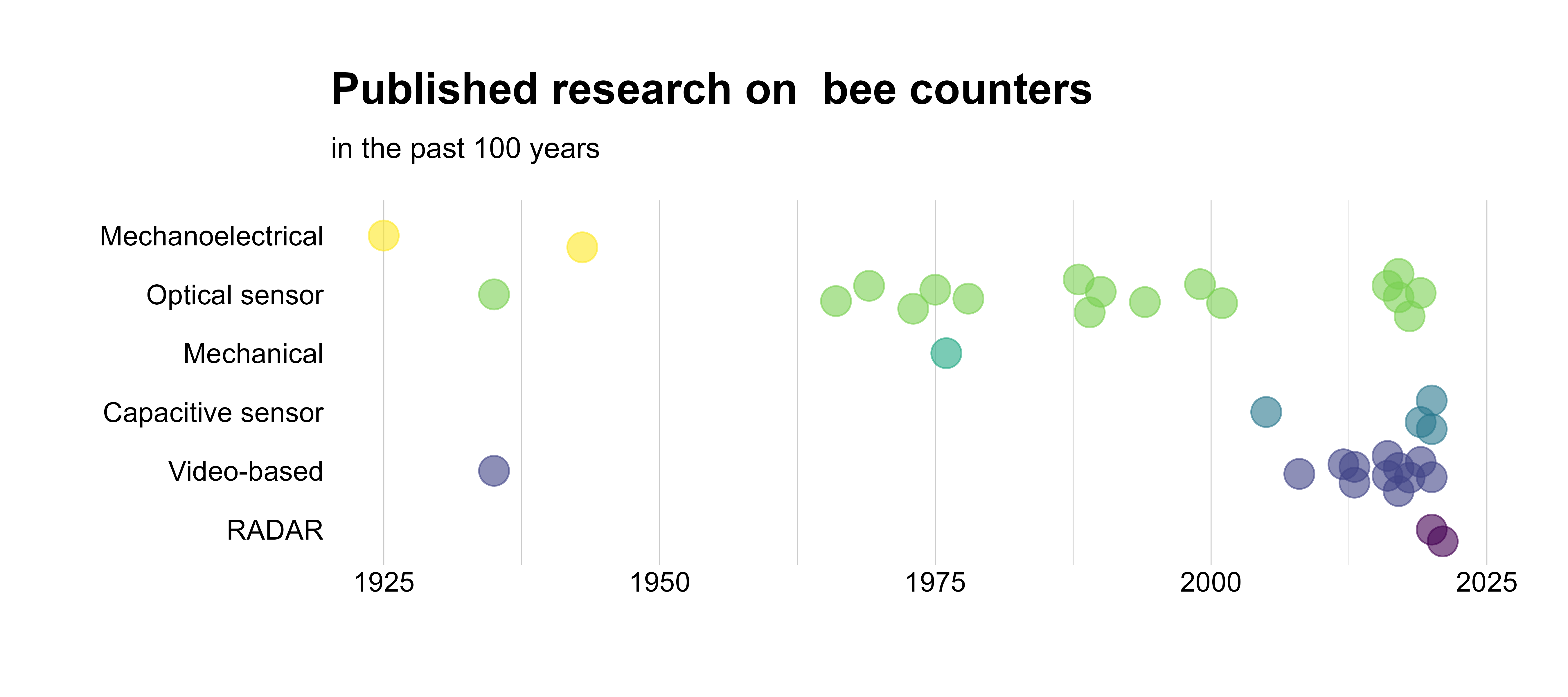
For nearly 100 years, researchers have developed electronic and automated bee counters to measure honey bee flight activity. These devices aim to record bees entering and leaving a hive without disturbing natural colony behaviour. Such data can support research on foraging activity, colony development, environmental stressors, pesticide effects and precision beekeeping.
Automated bee counters are especially attractive because they can collect continuous data over long periods. In contrast to manual observations, they can monitor colonies throughout the day and across entire field seasons. However, the usefulness of these data depends on one central condition: the counter must be validated.
What this review covers
This review summarises the historical development of automated bee counting devices, from early mechanical and electronic systems to modern optical, capacitive, RFID, radar and video-based approaches. It compares the strengths and limitations of different technologies and discusses how they can be used to measure honey bee flight activity.
The review also highlights a major gap in the field: many published bee counters have not been validated sufficiently, and validation methods differ strongly between studies. This makes it difficult to compare systems or to interpret the biological meaning of the data they generate.
Why validation is the key challenge
Counting bees at the hive entrance sounds simple, but in practice it is technically difficult. Bees may move slowly, turn around, meet each other in a passage, remain in front of sensors, pass in groups or repeatedly cross the detection zone. These behaviours can lead to false counts or incorrect classification of incoming and outgoing bees.
For scientific studies, and especially for ecotoxicological or regulatory applications, it is not enough to know that a counter records activity. Researchers need to know how accurate the counts are, under which field conditions errors occur and how these errors affect derived endpoints such as daily flight activity or daily loss rates.
Applications in bee research and precision beekeeping
Reliable automated bee counters could support several areas of honey bee research and beekeeping. They can help describe foraging dynamics, detect abnormal activity patterns, monitor colony responses to environmental stressors and improve our understanding of how colonies interact with their surroundings.
In precision beekeeping, flight activity data can complement hive scales, temperature sensors, humidity sensors and other monitoring tools. Together, these data streams may help detect changes in colony status, food availability, swarming behaviour or external disturbances.
Relevance for pesticide risk assessment
Automated bee counters may also become relevant for pesticide risk assessment. If incoming and outgoing bee traffic can be measured accurately, counters could help estimate daily losses of forager bees and detect changes in flight behaviour after exposure to stressors.
However, this requires very low error rates and standardised validation protocols. Without robust validation, bee counter data cannot be compared across studies and should not be used to draw strong conclusions about colony health or pesticide effects.
Conclusion
This review shows that automated bee counters have great potential for honey bee monitoring, precision beekeeping and ecological research. At the same time, it makes clear that technological progress alone is not enough. The next step is standardisation: bee counters need transparent validation methods, clear reporting of error rates and biologically meaningful interpretation of flight data.
In this sense, automated bee counters are not just monitoring devices. They are tools that can help connect bee biology, sensor technology and risk assessment — provided that their performance is tested under realistic field conditions.
Publication
Approaches, challenges and recent advances in automated bee counting devices: A review Journal Article
In: Annals of Aplied Biology, 2021.